
Seven Rounds of Surrender
I was recently told that a woman doesn’t marry; she is merely married.

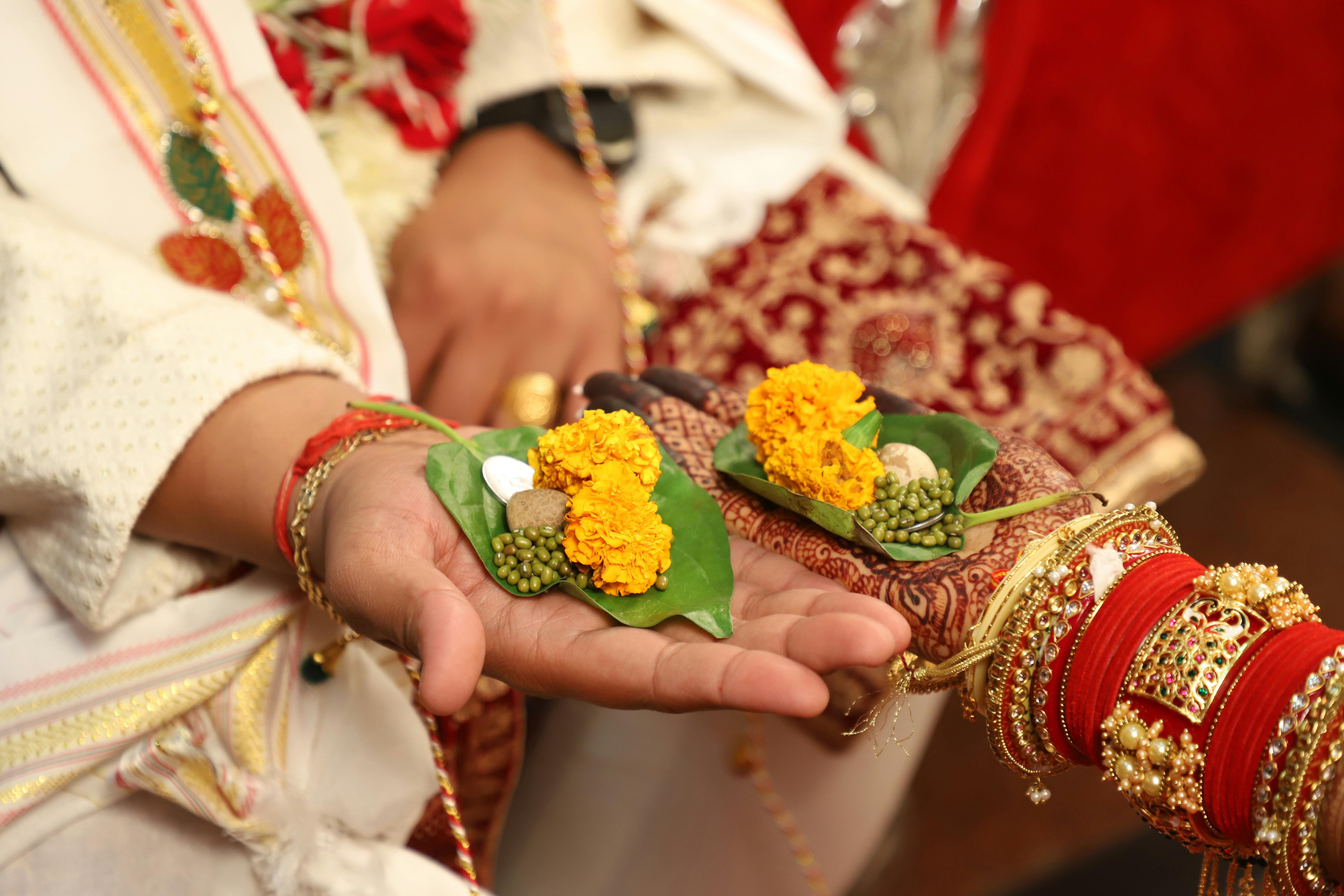
I was at a wedding recently when, three hours into the rituals, we heard the officiating priest ask the bride and groom to exit the mandap. Not anticipating this sudden departure of the couple, we friends became curious (and impatient) enough to ask what exactly was going on.
And what we heard definitely warrants a Substack.
The Hindu priest shared that we were witnessing the ceremonial time given to the groom to consider whether he wishes to accept the bride.
Once the woman, the priest tragically continued to overexplain, is given away by her father, she exists in a kind of interim state until the groom formally accepts her through the remaining rituals. Only then is she permitted to become a wife.
Meaning, a woman may exercise every ounce of agency to arrive at her own wedding ceremony, but within the language of the ritual, she still cannot choose to marry and instead must be chosen into it.
By this point, irony had already collapsed dramatically outside the venue, and I remember sitting there thinking: surely I have misunderstood this.
Because it is one thing to academically know that marriage, as an institution, cannot exist independently of patriarchy, and rule out the more obviously oppressive norms (such as a kanyadaan or being asked to touch your husband’s feet).
It is another thing entirely to have it be declared plainly to you that no matter how many rituals you selectively resist, the very act of being married ought not to be your prerogative as a woman.
Now I gather that women who would ever stumble upon this Substack have greater sociopolitical access and mobility than most Indian women can brag about. Hence, I don’t doubt that we all recognise the ludicrity of having, what could be one of the most emotionally significant moments of our lives, linguistically structured around our transfer.
Especially since our economy’s top 2% would consider the “big fat Indian wedding” that panders to family values to be one of our greatest exports to the West [think: Made in Heaven, Indian Matchmaking, the Ambani wedding]
And maybe this is where I begin to feel conflicted with my own feminism, and that of those around me.
Because while I have never particularly dreamt of marriage myself, I have friends who do. I do not think love is fake, nor do I think companionship is regressive. Plus, it’d be foolish not to recognise the obvious asset-building perks that ride on the back of (equal) marriages between two consenting partners.
But to willingly participate in a practice that fundamentally positions us beneath the person we love? I worry.
Perhaps it can be likened to what Woemaniyah writes in their Substack: “Western feminism often imagines liberation as exit. Choose yourself and leave the house. Brown women inherit a much more crowded building. We are expected to love the people who may limit us and protect the culture that frustrates us.”
Or is it as Jenny Sharpe wrote in their 2005 study on Gender, Nation, and Globalisation, that for Indians, “modernity is less the negation of tradition than the grounds for its formation.”
Or is it that we’d rather critique misogyny when it is explicit, violent, and grotesque? Especially if we’ve managed to find and seal a ‘good’ man worth overlooking all this for.
Perhaps the reason isn’t singular, and doesn’t matter much.
What I do think about is, what of us?
Is the automatic next step for every progressive, financially independent woman supposed to be the complete rejection of marriage itself? Or can weddings instead become sites of reclamation for us?
Do women with the privilege to negotiate rituals have a responsibility to slowly reshape the institution into something more equal and more humane for women who do not yet have the same freedom to challenge it?
This would be a good time to plug a viral video from a few weeks ago of a bride whose in-laws placed a little boy in her lap during a ceremony and insisted she refer to him as her “son,” supposedly to manifest male children into her future. She gently resisted as best she could until the groom intervened and firmly shut the ritual down.
While that specific video encourages action against microaggressions (and proves that rejecting norms lands more persuasively when coming from a man), other than the point of hiring a female priest, I don’t yet have all the notes. And I don’t intend on writing some grand anti-marriage manifesto either.
I just thought I’d share my lingering horror as a reminder that even if a woman spends her entire life building up to being her own person, she’d likely arrive at marriage and be told, very calmly, that she must still wait to be chosen.